
Learning objective
Cryptography
Cryptography & Unplugged Encryption
1
2
3
4
5
6
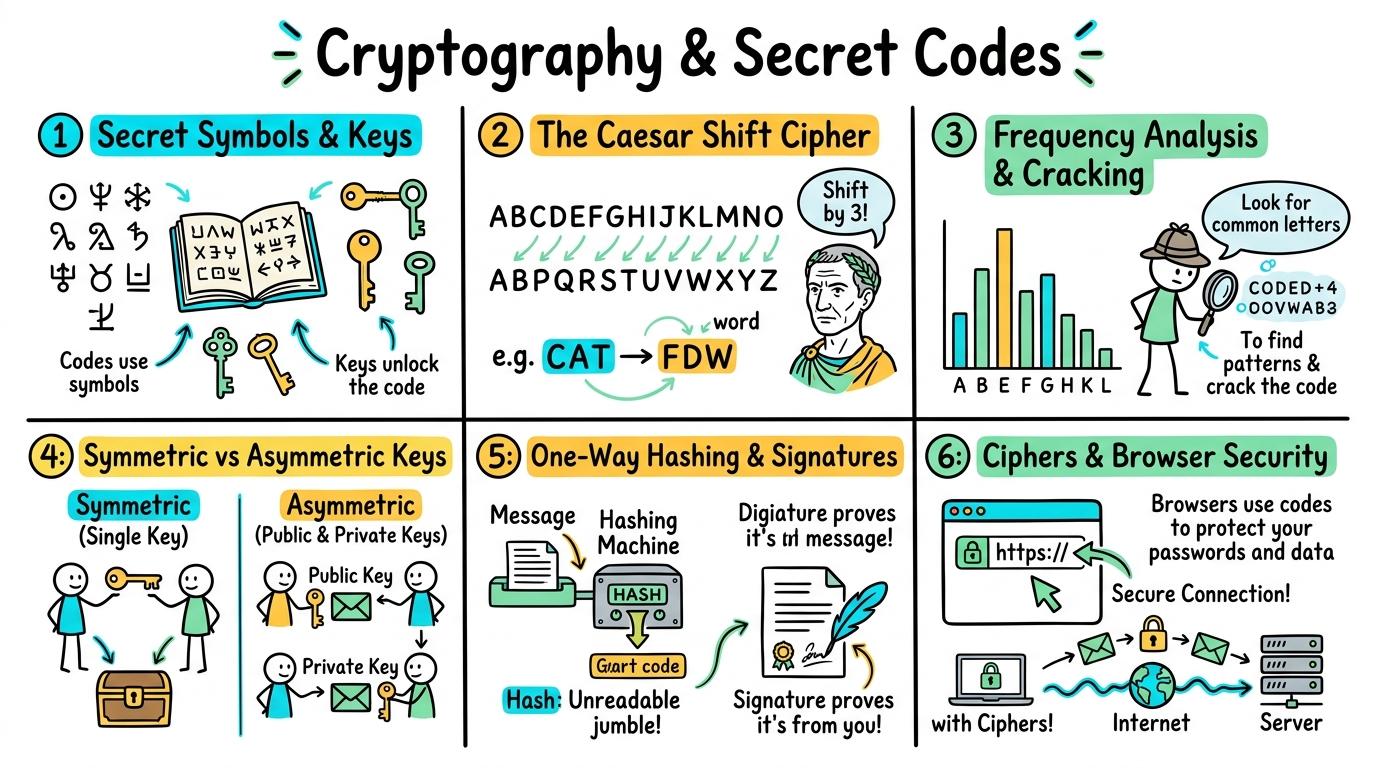
Unlocking the secret science of codes, ciphers, and digital data scrambling. Students progress from physical substitution ciphers to public-key encryption and modern hashing algorithms.
Secret Symbols & Keys
Understand that messages can be encoded using symbol substitution keys.
Let's Go!
Routine: See, Think, Wonder
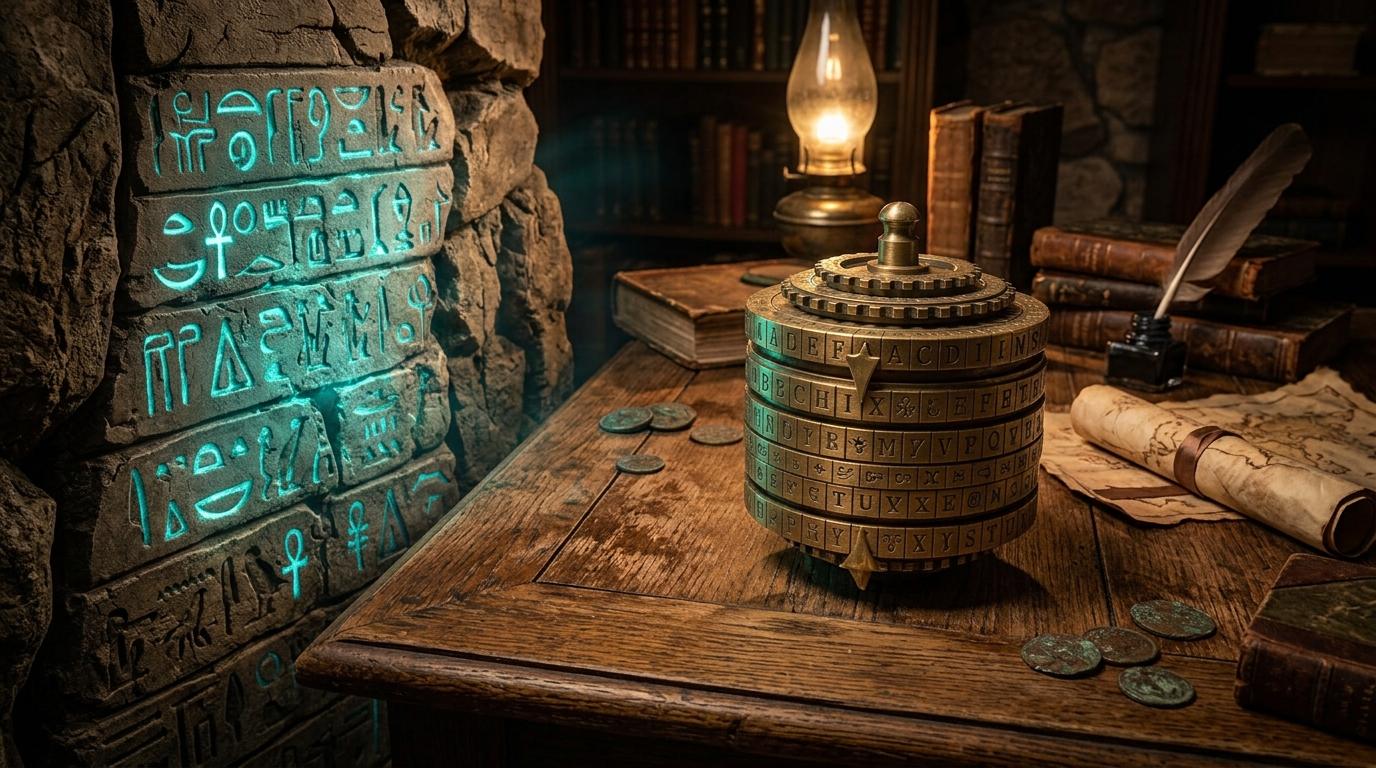
Look at these ancient secret symbols carved in stone. How do you think spies sent secret messages before phones existed?
Teacher note: Facilitate the See, Think, Wonder routine for 2–3 minutes. Encourage students to connect the prompt to Form (Symbols and codes allow people to transmit private messages.).
Learn
Cryptography is the science of secret writing! When you turn readable text (plaintext) into a secret code (ciphertext), you are 'encrypting' it. Anyone with the secret 'key' can turn it back into readable words ('decrypting'). In computing, symbols and codes allow people to transmit private messages. As you explore the interactive Cipher Wheel Simulator below, focus on how to decode an unknown short secret message using a substitution key without teacher assistance.
---
🧮 Modulo 26 Shift Formula
Mathematical definition of the Caesar shift with alphabet wrap-around:
Encryption: $E_n(x) = (x + n) \pmod26$
Decryption: $D_n(x) = (x - n) \pmod26$
Where $x$ is the letter index (0 = A, 1 = B, ..., 25 = Z) and $n$ is the shift key.
📊 Standard English Letter Frequencies
Expected distribution across 100,000 words in standard English corpora:
| Letter | Freq % | Letter | Freq % |
|---|---|---|---|
| E | 12.70% | T | 9.06% |
| A | 8.17% | O | 7.51% |
| I | 6.97% | N | 6.75% |
| S | 6.33% | H | 6.09% |
| R | 5.99% | D | 4.25% |
🔑 Asymmetric RSA Key Pair Architecture
Mathematical foundation of public/private key trapdoor one-way functions:
Primes: $p, q$ (Large random secret prime numbers)
Modulus: $n = p \times q$ (Public component)
Public Key: $(e, n)$ • Private Key: $(d, n)$
Factoring $n$ back into $p$ and $q$ takes thousands of years for 2048-bit keys on classical computers.
⚡ Cryptographic Hash Standard (NIST FIPS 180-4)
Algorithm:SHA-256 (Secure Hash Algorithm, 256-bit output)
Collision Resistance:$2^128$ operations required to find two different inputs with identical digests
Pre-image Resistance:Impossible to compute original text from digest ($2^256$ search space)
Apply Simulator Skills • Try it yourself
Decode the Spy Message
🚀 Open a practice space
🌟 Student Project GuideSuccess Criteria & WAGOLL (What A Good One Looks Like)
🎯 Task Success Criteria (Rubric)
Foundation
Matches a symbol on a decoder sheet to its matching alphabet letter.
Developing
Encodes a 4-letter word using a grid-based symbol key.
Secure (Goal)
Decodes an unknown short secret message using a substitution key without teacher assistance.
Mastery
Creates a custom symbol substitution key and explains why keeping the key secret is necessary for privacy.
👀 What A Good One Looks Like (WAGOLL)
 ⭐ Mastering Standard
📁
Save to Your Website Portfolio:
When you finish creating your project in your software, copy the share link or take a screenshot and publish it onto your student portfolio website!
Reflect
Learning check
Teacher setup, curriculum links and progress descriptors
Spark support
Routine: See, Think, Wonder
Teacher notes: Facilitate the See, Think, Wonder routine for 2–3 minutes. Encourage students to connect the prompt to Form (Symbols and codes allow people to transmit private messages.).
Achievement pathway
- Foundation: Matches a symbol on a decoder sheet to its matching alphabet letter.
- Developing: Encodes a 4-letter word using a grid-based symbol key.
- Secure: Decodes an unknown short secret message using a substitution key without teacher assistance.
- Mastering: Creates a custom symbol substitution key and explains why keeping the key secret is necessary for privacy.
Curriculum links
Curriculum strand: Everyday Digital Skills & Computational Science
Outcome: CY.01.B.1.1 — Understand that messages can be encoded using symbol substitution keys.
PYP: Form · Symbols and codes allow people to transmit private messages.
Learner profile: Inquirer
Competency tags
Gate support
Accessibility alternative: Students may verbally explain or point to the correct answer for "In cryptography, what is a 'Key'?" with a teacher or teaching assistant.
Teacher override: allow
Locked level
Level 2: The Caesar Shift Cipher
Complete the previous learning check to unlock this next level.
The Caesar Shift Cipher
Apply numeric shift algorithms (Caesar Cipher) to encode and decode text.
Learning objective
Students will shift alphabet letters by a numerical key (+3, -3) to encrypt and decrypt messages.
Let's Go!
Routine: Zoom In
Julius Caesar sent secret battle orders by shifting every letter 3 places down the alphabet. Why was this effective 2000 years ago?
Teacher note: Facilitate the Zoom In routine for 2–3 minutes. Encourage students to connect the prompt to Function (Mathematical shifts create predictable algorithmic patterns.).
Learn
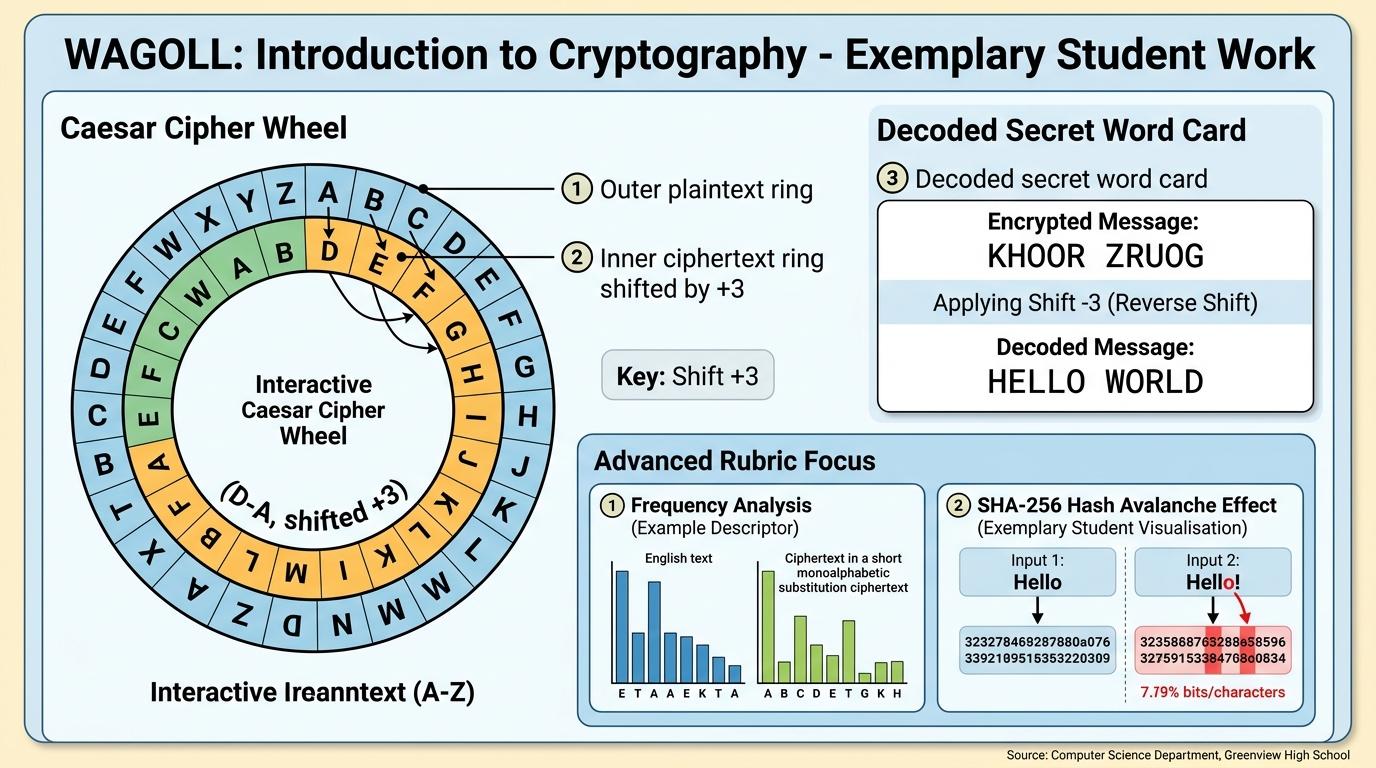
The Caesar Cipher is one of the oldest mathematical codes! You pick a shift number (like +3). 'A' becomes 'D', 'B' becomes 'E', and 'C' becomes 'F'. To read it, the recipient reverses the shift by subtracting 3. In computing, mathematical shifts create predictable algorithmic patterns. As you explore the interactive Cipher Wheel Simulator below, focus on how to decrypt a message using a Caesar shift of -3 and handles wrap-around letters (e.g. 'Z' shifting forward to 'C').
---
🧮 Modulo 26 Shift Formula
Mathematical definition of the Caesar shift with alphabet wrap-around:
Encryption: $E_n(x) = (x + n) \pmod26$
Decryption: $D_n(x) = (x - n) \pmod26$
Where $x$ is the letter index (0 = A, 1 = B, ..., 25 = Z) and $n$ is the shift key.
📊 Standard English Letter Frequencies
Expected distribution across 100,000 words in standard English corpora:
| Letter | Freq % | Letter | Freq % |
|---|---|---|---|
| E | 12.70% | T | 9.06% |
| A | 8.17% | O | 7.51% |
| I | 6.97% | N | 6.75% |
| S | 6.33% | H | 6.09% |
| R | 5.99% | D | 4.25% |
🔑 Asymmetric RSA Key Pair Architecture
Mathematical foundation of public/private key trapdoor one-way functions:
Primes: $p, q$ (Large random secret prime numbers)
Modulus: $n = p \times q$ (Public component)
Public Key: $(e, n)$ • Private Key: $(d, n)$
Factoring $n$ back into $p$ and $q$ takes thousands of years for 2048-bit keys on classical computers.
⚡ Cryptographic Hash Standard (NIST FIPS 180-4)
Algorithm:SHA-256 (Secure Hash Algorithm, 256-bit output)
Collision Resistance:$2^128$ operations required to find two different inputs with identical digests
Pre-image Resistance:Impossible to compute original text from digest ($2^256$ search space)
Apply Simulator Skills • Try it yourself
Caesar Cipher Wheel Challenge
🚀 Open a practice space
🌟 Student Project GuideSuccess Criteria & WAGOLL (What A Good One Looks Like)
🎯 Task Success Criteria (Rubric)
Foundation
Counts forward 3 alphabet steps from 'A' to find 'D'.
Developing
Encrypts a word using a Caesar shift of +3.
Secure (Goal)
Decrypts a message using a Caesar shift of -3 and handles wrap-around letters (e.g. 'Z' shifting forward to 'C').
Mastery
Calculates reverse shift keys and explains why small shift keys are vulnerable to brute-force cracking.
👀 What A Good One Looks Like (WAGOLL)
⭐ Mastering Standard📁
Save to Your Website Portfolio:
When you finish creating your project in your software, copy the share link or take a screenshot and publish it onto your student portfolio website!
Reflect
Learning check
Teacher setup, curriculum links and progress descriptors
Spark support
Routine: Zoom In
Teacher notes: Facilitate the Zoom In routine for 2–3 minutes. Encourage students to connect the prompt to Function (Mathematical shifts create predictable algorithmic patterns.).
Achievement pathway
- Foundation: Counts forward 3 alphabet steps from 'A' to find 'D'.
- Developing: Encrypts a word using a Caesar shift of +3.
- Secure: Decrypts a message using a Caesar shift of -3 and handles wrap-around letters (e.g. 'Z' shifting forward to 'C').
- Mastering: Calculates reverse shift keys and explains why small shift keys are vulnerable to brute-force cracking.
Curriculum links
Curriculum strand: Everyday Digital Skills & Computational Science
Outcome: CY.01.B.1.2 — Apply numeric shift algorithms (Caesar Cipher) to encode and decode text.
PYP: Function · Mathematical shifts create predictable algorithmic patterns.
Learner profile: Thinker
Competency tags
Gate support
Accessibility alternative: Students may verbally explain or point to the correct answer for "Using a Caesar Shift of +1, what does the word 'CAT' become when encrypted?" with a teacher or teaching assistant.
Teacher override: allow
Locked level
Level 3: Frequency Analysis & Code Cracking
Complete the previous learning check to unlock this next level.
Frequency Analysis & Code Cracking
Use letter frequency statistics to crack simple substitution ciphers without a key.
Learning objective
Students will count letter occurrences in an encrypted text to identify the most common letter ('E') and crack the cipher.
Let's Go!
Routine: Parts, Purposes, Complexities
Look at a page of any English book. Which letter appears more than any other?
How can a detective use this to crack codes?
Teacher note: Facilitate the Parts, Purposes, Complexities routine for 2–3 minutes. Encourage students to connect the prompt to Connection (Pattern analysis and data statistics reveal hidden structures.).
Learn
Codebreakers don't guess blindly—they use statistics! In English, the letter 'E' appears about 12% of the time, followed by 'T' and 'A'. If an encrypted message has the letter 'X' appearing dozens of times, 'X' is almost certainly 'E'! In computing, pattern analysis and data statistics reveal hidden structures. As you explore the interactive Cipher Wheel Simulator below, focus on how to use frequency analysis to deduce the shift key and decrypt an intercepted ciphertext without being given the key.
---
🧮 Modulo 26 Shift Formula
Mathematical definition of the Caesar shift with alphabet wrap-around:
Encryption: $E_n(x) = (x + n) \pmod26$
Decryption: $D_n(x) = (x - n) \pmod26$
Where $x$ is the letter index (0 = A, 1 = B, ..., 25 = Z) and $n$ is the shift key.
📊 Standard English Letter Frequencies
Expected distribution across 100,000 words in standard English corpora:
| Letter | Freq % | Letter | Freq % |
|---|---|---|---|
| E | 12.70% | T | 9.06% |
| A | 8.17% | O | 7.51% |
| I | 6.97% | N | 6.75% |
| S | 6.33% | H | 6.09% |
| R | 5.99% | D | 4.25% |
🔑 Asymmetric RSA Key Pair Architecture
Mathematical foundation of public/private key trapdoor one-way functions:
Primes: $p, q$ (Large random secret prime numbers)
Modulus: $n = p \times q$ (Public component)
Public Key: $(e, n)$ • Private Key: $(d, n)$
Factoring $n$ back into $p$ and $q$ takes thousands of years for 2048-bit keys on classical computers.
⚡ Cryptographic Hash Standard (NIST FIPS 180-4)
Algorithm:SHA-256 (Secure Hash Algorithm, 256-bit output)
Collision Resistance:$2^128$ operations required to find two different inputs with identical digests
Pre-image Resistance:Impossible to compute original text from digest ($2^256$ search space)
Apply Simulator Skills • Try it yourself
Be a Cryptanalyst
🚀 Open a practice space
🌟 Student Project GuideSuccess Criteria & WAGOLL (What A Good One Looks Like)
🎯 Task Success Criteria (Rubric)
Foundation
Identifies that 'E' and 'T' are the most common letters in English books.
Developing
Tallies letter counts in a short encrypted paragraph to find the most frequent symbol.
Secure (Goal)
Uses frequency analysis to deduce the shift key and decrypt an intercepted ciphertext without being given the key.
Mastery
Explains why simple substitution ciphers are easily broken by computers using statistical analysis.
👀 What A Good One Looks Like (WAGOLL)
⭐ Mastering Standard📁
Save to Your Website Portfolio:
When you finish creating your project in your software, copy the share link or take a screenshot and publish it onto your student portfolio website!
Reflect
Learning check
Teacher setup, curriculum links and progress descriptors
Spark support
Routine: Parts, Purposes, Complexities
Teacher notes: Facilitate the Parts, Purposes, Complexities routine for 2–3 minutes. Encourage students to connect the prompt to Connection (Pattern analysis and data statistics reveal hidden structures.).
Achievement pathway
- Foundation: Identifies that 'E' and 'T' are the most common letters in English books.
- Developing: Tallies letter counts in a short encrypted paragraph to find the most frequent symbol.
- Secure: Uses frequency analysis to deduce the shift key and decrypt an intercepted ciphertext without being given the key.
- Mastering: Explains why simple substitution ciphers are easily broken by computers using statistical analysis.
Curriculum links
Curriculum strand: Everyday Digital Skills & Computational Science
Outcome: CY.02.B.1.1 — Use letter frequency statistics to crack simple substitution ciphers without a key.
PYP: Connection · Pattern analysis and data statistics reveal hidden structures.
Learner profile: Knowledgeable
Competency tags
Gate support
Accessibility alternative: Students may verbally explain or point to the correct answer for "You intercepted a secret message where the letter 'Q' appears 25 times, far more than any other letter. What should you guess 'Q' represents?" with a teacher or teaching assistant.
Teacher override: allow
Locked level
Level 4: Symmetric vs Asymmetric Encryption
Complete the previous learning check to unlock this next level.
Symmetric vs Asymmetric Encryption
Differentiate between single-key (symmetric) and dual-key (public/private key) encryption.
Learning objective
Students will demonstrate how public and private key pairs allow secure web communication without sharing secret passwords.
Let's Go!
Routine: What If...?
What if you want to send a locked treasure chest to a friend across the ocean, but you can't mail the key safely?
How can you solve this?
Teacher note: Facilitate the What If...? routine for 2–3 minutes. Encourage students to connect the prompt to Perspective (Secure global communication relies on mathematical key pairs.).
Learn
Symmetric encryption uses ONE key to lock and unlock. But how do you share that key safely online? Asymmetric encryption solves this with TWO keys: a PUBLIC key (like an open padlock anyone can use to lock a box) and a PRIVATE key (the only key that unlocks it)!
---
🧮 Modulo 26 Shift Formula
Mathematical definition of the Caesar shift with alphabet wrap-around:
Encryption: $E_n(x) = (x + n) \pmod26$
Decryption: $D_n(x) = (x - n) \pmod26$
Where $x$ is the letter index (0 = A, 1 = B, ..., 25 = Z) and $n$ is the shift key.
📊 Standard English Letter Frequencies
Expected distribution across 100,000 words in standard English corpora:
| Letter | Freq % | Letter | Freq % |
|---|---|---|---|
| E | 12.70% | T | 9.06% |
| A | 8.17% | O | 7.51% |
| I | 6.97% | N | 6.75% |
| S | 6.33% | H | 6.09% |
| R | 5.99% | D | 4.25% |
🔑 Asymmetric RSA Key Pair Architecture
Mathematical foundation of public/private key trapdoor one-way functions:
Primes: $p, q$ (Large random secret prime numbers)
Modulus: $n = p \times q$ (Public component)
Public Key: $(e, n)$ • Private Key: $(d, n)$
Factoring $n$ back into $p$ and $q$ takes thousands of years for 2048-bit keys on classical computers.
⚡ Cryptographic Hash Standard (NIST FIPS 180-4)
Algorithm:SHA-256 (Secure Hash Algorithm, 256-bit output)
Collision Resistance:$2^128$ operations required to find two different inputs with identical digests
Pre-image Resistance:Impossible to compute original text from digest ($2^256$ search space)
Apply Simulator Skills • Try it yourself
Public Key Padlock Simulation
🚀 Open a practice space
🌟 Student Project GuideSuccess Criteria & WAGOLL (What A Good One Looks Like)
🎯 Task Success Criteria (Rubric)
Foundation
States that websites use secret encryption to protect credit cards and passwords.
Developing
Explains the problem with symmetric keys: if you send the secret key over the internet, someone could intercept it.
Secure (Goal)
Role-plays Public/Private key exchange using the 'Padlock & Box' analogy (Public key = open padlock everyone can lock; Private key = secret key only you hold).
Mastery
Explains how HTTPS and SSL certificates use asymmetric encryption to establish secure internet connections.
👀 What A Good One Looks Like (WAGOLL)
⭐ Mastering Standard📁
Save to Your Website Portfolio:
When you finish creating your project in your software, copy the share link or take a screenshot and publish it onto your student portfolio website!
Reflect
Learning check
Teacher setup, curriculum links and progress descriptors
Spark support
Routine: What If...?
Teacher notes: Facilitate the What If...? routine for 2–3 minutes. Encourage students to connect the prompt to Perspective (Secure global communication relies on mathematical key pairs.).
Achievement pathway
- Foundation: States that websites use secret encryption to protect credit cards and passwords.
- Developing: Explains the problem with symmetric keys: if you send the secret key over the internet, someone could intercept it.
- Secure: Role-plays Public/Private key exchange using the 'Padlock & Box' analogy (Public key = open padlock everyone can lock; Private key = secret key only you hold).
- Mastering: Explains how HTTPS and SSL certificates use asymmetric encryption to establish secure internet connections.
Curriculum links
Curriculum strand: Everyday Digital Skills & Computational Science
Outcome: CY.02.B.1.2 — Differentiate between single-key (symmetric) and dual-key (public/private key) encryption.
PYP: Perspective · Secure global communication relies on mathematical key pairs.
Learner profile: Open-minded
Competency tags
Gate support
Accessibility alternative: Students may verbally explain or point to the correct answer for "In Public-Key (Asymmetric) Encryption, which key must you NEVER share with anyone?" with a teacher or teaching assistant.
Teacher override: allow
Locked level
Level 5: One-Way Hashing & Data Integrity
Complete the previous learning check to unlock this next level.
One-Way Hashing & Data Integrity
Explain one-way cryptographic hash functions and their role in password storage and file integrity.
Learning objective
Students will demonstrate that a hash function creates a unique, fixed-length fingerprint that changes completely if even one character is altered.
Let's Go!
Routine: See, Think, Wonder
Imagine blending an apple and a banana into a smoothie. Can you 'un-blend' the smoothie back into an apple?
How is this like a computer hash?
Teacher note: Facilitate the See, Think, Wonder routine for 2–3 minutes. Encourage students to connect the prompt to Change (Irreversible digital signatures guarantee data authenticity and security.).
Learn
A Hash Function is like a digital blender! It takes any text or file and turns it into a unique string of characters (like `e3b0c442...`). It is a ONE-WAY process: you cannot reverse a hash back to the original text. Websites store password hashes so hackers can't read your real password!
---
🧮 Modulo 26 Shift Formula
Mathematical definition of the Caesar shift with alphabet wrap-around:
Encryption: $E_n(x) = (x + n) \pmod26$
Decryption: $D_n(x) = (x - n) \pmod26$
Where $x$ is the letter index (0 = A, 1 = B, ..., 25 = Z) and $n$ is the shift key.
📊 Standard English Letter Frequencies
Expected distribution across 100,000 words in standard English corpora:
| Letter | Freq % | Letter | Freq % |
|---|---|---|---|
| E | 12.70% | T | 9.06% |
| A | 8.17% | O | 7.51% |
| I | 6.97% | N | 6.75% |
| S | 6.33% | H | 6.09% |
| R | 5.99% | D | 4.25% |
🔑 Asymmetric RSA Key Pair Architecture
Mathematical foundation of public/private key trapdoor one-way functions:
Primes: $p, q$ (Large random secret prime numbers)
Modulus: $n = p \times q$ (Public component)
Public Key: $(e, n)$ • Private Key: $(d, n)$
Factoring $n$ back into $p$ and $q$ takes thousands of years for 2048-bit keys on classical computers.
⚡ Cryptographic Hash Standard (NIST FIPS 180-4)
Algorithm:SHA-256 (Secure Hash Algorithm, 256-bit output)
Collision Resistance:$2^128$ operations required to find two different inputs with identical digests
Pre-image Resistance:Impossible to compute original text from digest ($2^256$ search space)
Apply Simulator Skills • Try it yourself
Test the Avalanche Effect
🚀 Open a practice space
🌟 Student Project GuideSuccess Criteria & WAGOLL (What A Good One Looks Like)
🎯 Task Success Criteria (Rubric)
Foundation
Understands that websites store passwords in a scrambled form rather than plain text.
Developing
Observed that changing 1 letter in an input produces a completely different hash output (Avalanche Effect).
Secure (Goal)
Explains why hashing is a 1-way function (easy to compute forward, impossible to reverse back into the password).
Mastery
Demonstrates how file checksums (hashes) verify if a downloaded file has been tampered with or corrupted.
👀 What A Good One Looks Like (WAGOLL)
⭐ Mastering Standard📁
Save to Your Website Portfolio:
When you finish creating your project in your software, copy the share link or take a screenshot and publish it onto your student portfolio website!
Reflect
Learning check
Teacher setup, curriculum links and progress descriptors
Spark support
Routine: See, Think, Wonder
Teacher notes: Facilitate the See, Think, Wonder routine for 2–3 minutes. Encourage students to connect the prompt to Change (Irreversible digital signatures guarantee data authenticity and security.).
Achievement pathway
- Foundation: Understands that websites store passwords in a scrambled form rather than plain text.
- Developing: Observed that changing 1 letter in an input produces a completely different hash output (Avalanche Effect).
- Secure: Explains why hashing is a 1-way function (easy to compute forward, impossible to reverse back into the password).
- Mastering: Demonstrates how file checksums (hashes) verify if a downloaded file has been tampered with or corrupted.
Curriculum links
Curriculum strand: Everyday Digital Skills & Computational Science
Outcome: CY.03.B.1.1 — Explain one-way cryptographic hash functions and their role in password storage and file integrity.
PYP: Change · Irreversible digital signatures guarantee data authenticity and security.
Learner profile: Principled
Competency tags
Gate support
Accessibility alternative: Students may verbally explain or point to the correct answer for "What makes a cryptographic hash function different from normal encryption?" with a teacher or teaching assistant.
Teacher override: allow
Locked level
Level 6: Cybersecurity & Ciphers Audit
Complete the previous learning check to unlock this next level.
Cybersecurity & Ciphers Audit
Evaluate real-world cryptographic applications (HTTPS, Wifi WPA3, Blockchain) and design a secure communication system.
Learning objective
Students will audit a simulated school network connection, identifying where encryption (HTTPS/WPA3) protects data in transit.
Let's Go!
Routine: 3-2-1 Bridge
3 place encryption protects you daily, 2 risks of unencrypted networks, 1 reason cryptography is essential for modern society.
Teacher note: Facilitate the 3-2-1 Bridge routine for 2–3 minutes. Encourage students to connect the prompt to Responsibility (Robust security infrastructure protects human privacy and global systems.).
Learn
Encryption is the invisible shield of the internet! Every time you see `https://` and a padlock in your browser, your connection is using SSL/TLS encryption. Without cryptography, online banking, private messaging, and secure voting would be impossible. In computing, robust security infrastructure protects human privacy and global systems. As you explore the interactive Cipher Wheel Simulator below, focus on how to construct a full security diagram mapping how data moves from user device -> Wi-Fi encryption -> HTTPS web server.
---
🧮 Modulo 26 Shift Formula
Mathematical definition of the Caesar shift with alphabet wrap-around:
Encryption: $E_n(x) = (x + n) \pmod26$
Decryption: $D_n(x) = (x - n) \pmod26$
Where $x$ is the letter index (0 = A, 1 = B, ..., 25 = Z) and $n$ is the shift key.
📊 Standard English Letter Frequencies
Expected distribution across 100,000 words in standard English corpora:
| Letter | Freq % | Letter | Freq % |
|---|---|---|---|
| E | 12.70% | T | 9.06% |
| A | 8.17% | O | 7.51% |
| I | 6.97% | N | 6.75% |
| S | 6.33% | H | 6.09% |
| R | 5.99% | D | 4.25% |
🔑 Asymmetric RSA Key Pair Architecture
Mathematical foundation of public/private key trapdoor one-way functions:
Primes: $p, q$ (Large random secret prime numbers)
Modulus: $n = p \times q$ (Public component)
Public Key: $(e, n)$ • Private Key: $(d, n)$
Factoring $n$ back into $p$ and $q$ takes thousands of years for 2048-bit keys on classical computers.
⚡ Cryptographic Hash Standard (NIST FIPS 180-4)
Algorithm:SHA-256 (Secure Hash Algorithm, 256-bit output)
Collision Resistance:$2^128$ operations required to find two different inputs with identical digests
Pre-image Resistance:Impossible to compute original text from digest ($2^256$ search space)
Apply Simulator Skills • Try it yourself
School Network Security Audit
🚀 Open a practice space
🌟 Student Project GuideSuccess Criteria & WAGOLL (What A Good One Looks Like)
🎯 Task Success Criteria (Rubric)
Foundation
Locates the padlock icon in a browser address bar indicating HTTPS encryption.
Developing
Explains the risk of sending unencrypted data over public open Wi-Fi networks.
Secure (Goal)
Constructs a full security diagram mapping how data moves from user device -> Wi-Fi encryption -> HTTPS web server.
Mastery
Evaluates emerging cryptographic concepts (Quantum computing threats to encryption) and presents a security recommendation report.
👀 What A Good One Looks Like (WAGOLL)
⭐ Mastering Standard📁
Save to Your Website Portfolio:
When you finish creating your project in your software, copy the share link or take a screenshot and publish it onto your student portfolio website!
Reflect
Learning check
Teacher setup, curriculum links and progress descriptors
Spark support
Routine: 3-2-1 Bridge
Teacher notes: Facilitate the 3-2-1 Bridge routine for 2–3 minutes. Encourage students to connect the prompt to Responsibility (Robust security infrastructure protects human privacy and global systems.).
Achievement pathway
- Foundation: Locates the padlock icon in a browser address bar indicating HTTPS encryption.
- Developing: Explains the risk of sending unencrypted data over public open Wi-Fi networks.
- Secure: Constructs a full security diagram mapping how data moves from user device -> Wi-Fi encryption -> HTTPS web server.
- Mastering: Evaluates emerging cryptographic concepts (Quantum computing threats to encryption) and presents a security recommendation report.
Curriculum links
Curriculum strand: Everyday Digital Skills & Computational Science
Outcome: CY.03.B.1.2 — Evaluate real-world cryptographic applications (HTTPS, Wifi WPA3, Blockchain) and design a secure communication system.
PYP: Responsibility · Robust security infrastructure protects human privacy and global systems.
Learner profile: Reflective
Competency tags
Gate support
Accessibility alternative: Students may verbally explain or point to the correct answer for "What does the padlock icon next to a web address (HTTPS) tell you?" with a teacher or teaching assistant.
Teacher override: allow